Net-Map
.png)
What is Net-Map?
Net-Map is an interview-based mapping tool that helps people understand, visualize, discuss, and improve situations in which many different actors influence outcomes (Net-Map Brochure: 679 KB). By creating Influence Network Maps, individuals and groups can clarify their own view of a situation, foster discussion, and develop a strategic approach to their networking activities. More specifically, Net-Map helps players to determine:
what actors are involved in a given network,
how they are linked,
how influential they are.
and what their goals are.
Determining linkages, levels of influence, and goals allows users to be more strategic about how they act in these complex situations. It helps users to answer questions such as: Do you need to strengthen the links to an influential potential supporter (high influence, same goals)? Do you have to be aware of an influential actor who doesn’t share your goals? Can increased networking help empower your dis-empowered beneficiaries?
what actors are involved in a given network,
how they are linked,
how influential they are.
and what their goals are.
Determining linkages, levels of influence, and goals allows users to be more strategic about how they act in these complex situations. It helps users to answer questions such as: Do you need to strengthen the links to an influential potential supporter (high influence, same goals)? Do you have to be aware of an influential actor who doesn’t share your goals? Can increased networking help empower your dis-empowered beneficiaries?
Equipment needed:
• Large sheets of paper for network map(one per interview, at least A3, better A2).
• Felt pens for drawing links(different colors according to different links).
• Adhesive paper as actor cards(“post-it” possibly different colors for different kinds of actors).
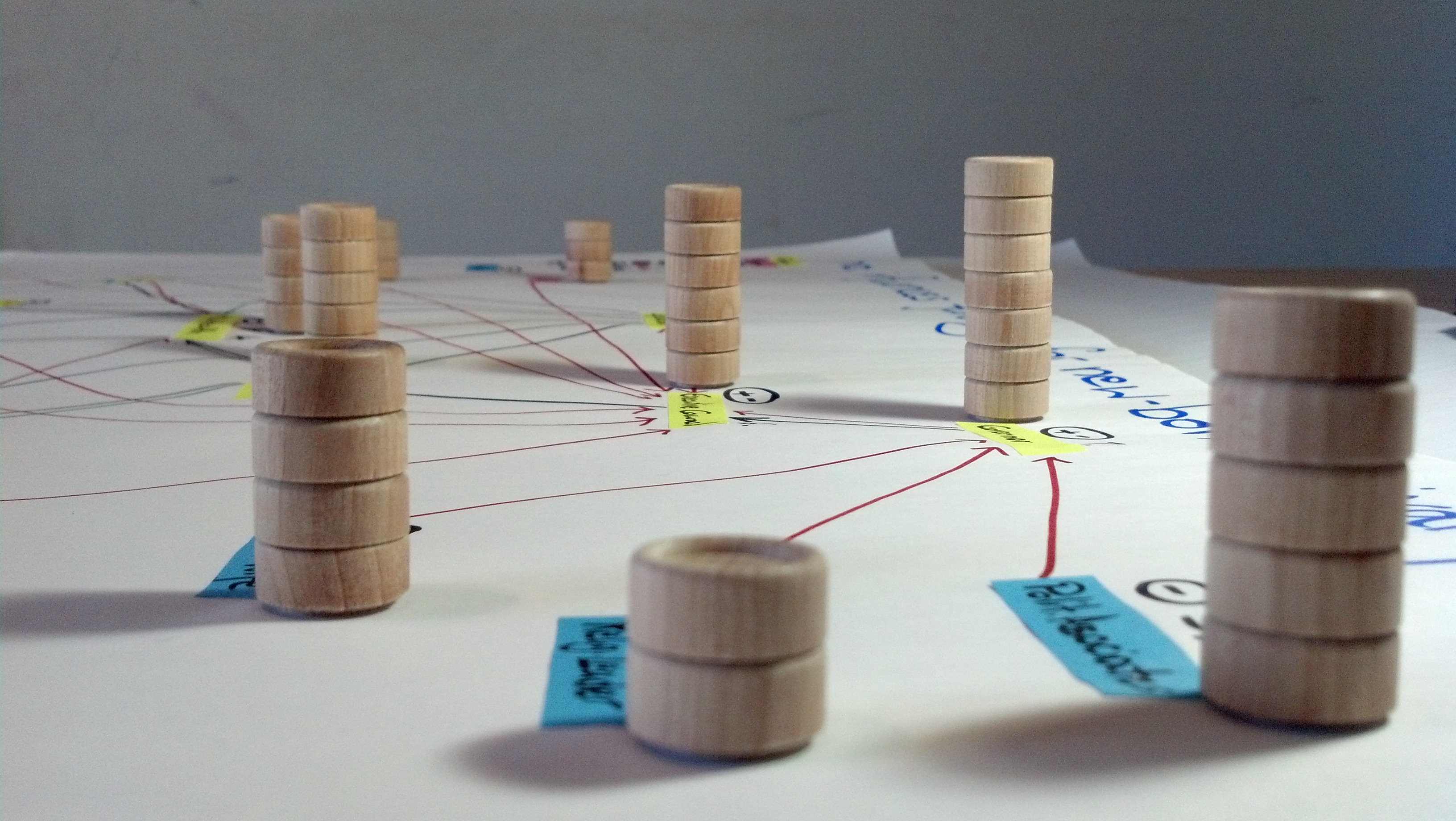
•Flat round stackable discs for building influence-towers (e.g. checker’s pieces, bicycle spare parts).
• Actor figurines (different board game figures, optional but especially useful when working with illiterate interviewees).
Net-Map step-by-step manual: short version (555 KB), detailed version in English (248 KB) and Portuguese (852 KB)training slide show (876 K).
1. Preparation:
• Define question (e.g. “Who can influence the success of our project?”).
• Define links (e.g. giving money, disturbing someone, giving support, giving command) and assign different colors to the links (i.e. giving money = red link).
• Define goals (e.g. environmental orientation and development orientation or pro and contra a change of legislation).
• Decide who should be involved in interviews / discussion.
2. Actor selection:
• Ask: “Who is involved in this process?”
• Write names on actor cards and distribute on empty Net-Map sheet.
3. Drawing of links:
• Ask: “Who is linked to whom?” Go through the different kinds of links one by one (e.g. “Who gives money to whom? Who disturbs whom?”).
• Draw arrows between actor cards according to interviewees directions.If two actors exchange something (e.g. information) draw double headed arrows. If actors exchange more than one thing, add differently colored arrow heads to existing links.
4. Goals
• Ask according to pre-defined goals, actor by actor, e.g. “Does this actor support environmental, developmental goals or both?”
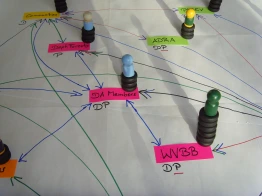
• Note abbreviations for goals next to actor cards, allow for multiple goals where appropriate, by noting more than one goal next to the actor (see picture 4).
5. Influence Towers
• Ask: “How strongly can actors influence xy?”
• Explain / agree on a definition of influence with your interviewee, clarify that this is about influence on xy and not influence in the world at large.
• Ask interviewee to assign influence towers to actors: The higher the influence on the issue at stake, the higher the tower. Towers of different actors can be of the same height. Actors with no influence can be put on ground level. Towers can be as high as interviewees want.
• Place influence towers next to actor cards.
• Verbalize set-up and give interviewee the chance to adjust towers before noting height of tower on the Net-Map (important for documentation purpose).
6. Discussion
• According to specific goal of your Net-Map exercise, discuss what this network means for strategy of organization, where influence comes from, what happens in case of conflicting goals etc.
• Missing: Link to three key Net-Map resources
Image 1
Image 2
Image 3
Image 4
• Felt pens for drawing links(different colors according to different links).
• Adhesive paper as actor cards(“post-it” possibly different colors for different kinds of actors).
•Flat round stackable discs for building influence-towers (e.g. checker’s pieces, bicycle spare parts).
• Actor figurines (different board game figures, optional but especially useful when working with illiterate interviewees).
Net-Map step-by-step manual: short version (555 KB), detailed version in English (248 KB) and Portuguese (852 KB)training slide show (876 K).
1. Preparation:
• Define question (e.g. “Who can influence the success of our project?”).
• Define links (e.g. giving money, disturbing someone, giving support, giving command) and assign different colors to the links (i.e. giving money = red link).
• Define goals (e.g. environmental orientation and development orientation or pro and contra a change of legislation).
• Decide who should be involved in interviews / discussion.
2. Actor selection:
• Ask: “Who is involved in this process?”
• Write names on actor cards and distribute on empty Net-Map sheet.
3. Drawing of links:
• Ask: “Who is linked to whom?” Go through the different kinds of links one by one (e.g. “Who gives money to whom? Who disturbs whom?”).
• Draw arrows between actor cards according to interviewees directions.If two actors exchange something (e.g. information) draw double headed arrows. If actors exchange more than one thing, add differently colored arrow heads to existing links.
4. Goals
• Ask according to pre-defined goals, actor by actor, e.g. “Does this actor support environmental, developmental goals or both?”
• Note abbreviations for goals next to actor cards, allow for multiple goals where appropriate, by noting more than one goal next to the actor (see picture 4).
5. Influence Towers
• Ask: “How strongly can actors influence xy?”
• Explain / agree on a definition of influence with your interviewee, clarify that this is about influence on xy and not influence in the world at large.
• Ask interviewee to assign influence towers to actors: The higher the influence on the issue at stake, the higher the tower. Towers of different actors can be of the same height. Actors with no influence can be put on ground level. Towers can be as high as interviewees want.
• Place influence towers next to actor cards.
• Verbalize set-up and give interviewee the chance to adjust towers before noting height of tower on the Net-Map (important for documentation purpose).
6. Discussion
• According to specific goal of your Net-Map exercise, discuss what this network means for strategy of organization, where influence comes from, what happens in case of conflicting goals etc.
• Missing: Link to three key Net-Map resources
Image 1
Image 2
Image 3
Image 4